For wheelchair users who can transfer independently into a vehicle, transporting a wheelchair efficiently becomes a key challenge. A roof box wheelchair hoist or wheelchair car roof hoist provides a practical solution by lifting and storing the wheelchair on the roof, freeing interior space and reducing physical effort.
This guide explains how roof mounted wheelchair hoist systems work, compares them with other solutions, and helps you decide whether a wheelchair lift hoist is the right choice for your vehicle.
Structured Summary
Definition: A roof-mounted hoist system lifts a folded wheelchair onto a vehicle roof for storage
Best for: Manual wheelchair users with independent transfer ability
Key benefit: Saves interior space and reduces lifting strain
Main limitation: Typically not suitable for heavy power wheelchairs
Alternative: Boot hoists or interior hoist systems
What Is a Roof Box Wheelchair Hoist
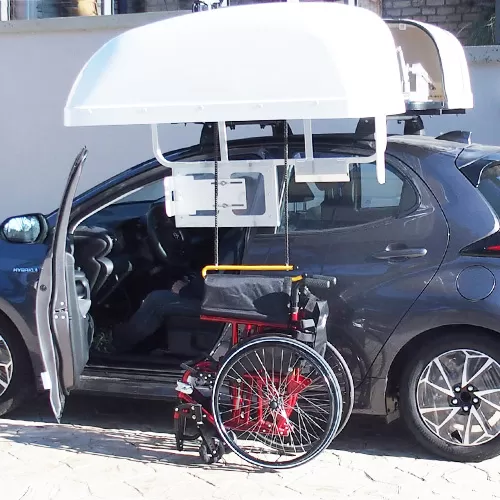
A roof box wheelchair hoist is a motorized or assisted lifting system mounted on top of a vehicle. It lifts a folded wheelchair from ground level into a roof storage box using a hook and cable mechanism. Standard operation process:
The user transfers from wheelchair to car seat
A hook lowers from the roof system
The wheelchair is attached and lifted upward
The chair is stored inside a roof-mounted box
This type of hoist wheelchair system is designed primarily for manual wheelchairs and emphasizes independent use. Buyers can review a roof mounted wheelchair hoist according to wheelchair dimensions, rated load, vehicle roof structure, operating method, and overall vehicle-height restrictions.
How a Wheelchair Car Roof Hoist Works
Most wheelchair car roof hoist systems follow a similar working principle:
Electric motor or assisted lifting mechanism
Hook or sling attachment for the wheelchair
Guided track or enclosure for storage
Modern systems allow operation via remote or dashboard control, enabling users to load the wheelchair without leaving the driver’s seat in some configurations. Compared to manual lifting, these systems significantly reduce strain and improve consistency during daily use.
Types of Wheelchair Lift Hoist Systems
Roof Mounted Wheelchair Hoist
A roof mounted wheelchair hoist stores the wheelchair externally on top of the vehicle. Key advantages:
Frees up trunk and cabin space
Enables independent loading
Minimal interior modification
Limitations:
Interior Hoist Systems
Interior hoists lift the wheelchair into the cargo area. Features:
These systems are common in SUVs and vans.
Boot Hoists
Boot hoists load the wheelchair directly into the trunk. Benefits:
Drawback:
Roof Hoist vs Boot Hoist Comparison
| Factor | Roof Box Wheelchair Hoist | Boot Hoist |
|---|
| Storage location | Roof | Trunk |
| Interior space | Fully preserved | Reduced |
| Suitable wheelchair | Manual only | Manual and some powered |
| Ease of use | High for independent users | Easier for caregivers |
| Vehicle modification | Moderate | Low to moderate |
Key Factors When Choosing a Roof Mounted Wheelchair Hoist
1. Wheelchair Type and Weight
Most roof mounted wheelchair hoist systems support around 40–50 kg and are designed for folding manual wheelchairs. They are generally not suitable for heavy electric wheelchairs.
2. User Independence Level
These systems are ideal for:
They may not be suitable for users who remain seated in the wheelchair during transport.
3. Vehicle Compatibility
Check:
Roof systems increase overall vehicle height, which can affect parking access.
4. Storage and Space Requirements
A key advantage is freeing up:
This makes roof systems especially useful for travel scenarios.
5. Installation and Power Supply
Most systems require:
Connection to vehicle power
Professional installation
Integration with roof structure
Some solutions support non-destructive installation and compatibility across different vehicle types.
Common Mistakes to Avoid
When selecting a wheelchair lift hoist, avoid these common issues:
Choosing a roof hoist for a power wheelchair
Ignoring vehicle height restrictions
Overlooking installation complexity
Not considering daily usage frequency
Selecting based only on price
These mistakes often lead to poor usability or additional costs.
How Xinder Roof Hoist Systems Fit Real Use Scenarios
Xinder provides integrated solutions including:
Their systems are designed to:
Support independent loading
Maintain vehicle interior space
Adapt to different vehicle types
This practical approach aligns with real-world mobility needs rather than overcomplicated configurations.
Conclusion
A roof box wheelchair hoist is a highly effective solution for users who prioritize independence and interior space. While not suitable for all wheelchair types, it offers clear advantages in convenience and usability. Choosing the right system depends on:
When matched correctly, a wheelchair car roof hoist can significantly improve daily mobility and reduce physical strain.
FAQ
What is a roof mounted wheelchair hoist
A roof mounted wheelchair hoist is a system that lifts a folded wheelchair onto a vehicle roof for storage using a motorized mechanism.
Can a roof hoist lift a power wheelchair
Most roof hoists are designed for manual wheelchairs and cannot support heavy power chairs.
Is a roof box wheelchair hoist easy to use
Yes, especially for users who can transfer independently, as many systems allow controlled lifting with minimal effort.
Does a roof hoist affect vehicle height
Yes, it increases overall height, which may limit access to low parking areas.










 English
  한국어
한국어  français
  Deutsch
  Español
  italiano
  русский
  português
  Malay
Malay  Indonesia
  العربية